I Rebuilt My Blog in One Afternoon Without Learning to Code

Claude and a WordPress MCP connector did the coding, so this analytics consultant didn’t have to

I’ve been doing this, the speaking, the writing, the podcast, co-leading the Nashville Power BI User Group, the community work, for over ten years now. Tableau Ambassador content, Power BI and Fabric deep dives, conference talks, Ten Minute Tuesday episodes, migration write-ups. And almost none of it lived in one place. I launched sqlsekou.com back in 2017, built mostly by hand, and hadn’t touched it since 2020. Everything since then, the newer work, the current version of what I actually do, was scattered across Substack, LinkedIn, wherever I happened to post that week, with my own website frozen in time.
That’s the problem I finally sat down to solve: not a new piece of content, but a home for all of it. One place where someone could land, see the full picture of what I do, and actually find the work.
I live in SQL, DAX, and LOD expressions. Not PHP.
I want to be upfront about something before I get into how this happened: I’m not a software developer or a WordPress developer. My world is data analytics and consulting, SQL queries, DAX measures in Power BI, LOD expressions in Tableau, the kind of logic that shapes a dataset, not the kind that renders a webpage. A full website rebuild used to be exactly the kind of project I’d have to hire out or shelve indefinitely, because “just edit the theme files” has never meant anything to me.
What’s changed is how much I’ve been leaning on AI and cloud tools to close that gap myself. I’ve been doing this on the data side for a while now, using agentic AI to build out Power BI semantic models, and increasingly for Tableau and general data work too, this isn’t just a Power BI habit. This was the first time I turned that same approach on my own website, and it worked the same way it does with a dataset: I don’t need to know the syntax if I can direct the work and judge the output. That’s genuinely a game changer for someone whose skill set stops at the data layer.
Where this actually started
I didn’t wake up one day and decide to rebuild sqlsekou.com. I came across Darrel Wilson’s “How to Connect Claude to WordPress” video, and that was the moment it clicked. Credit where it’s due, that video is what put the idea in my head in the first place. A frozen 2017 site and an agent that could actually operate on it directly were sitting right next to each other, I just hadn’t put the two together yet. That’s what sent me looking for the right connector.
Letting the agent actually do it
The unlock was a tool called Novamira, a free, open-source MCP connector (also on GitHub) that gives an AI agent real, direct access to a WordPress site: file system, WP-CLI, a PHP execution ability, the works. I connected it to sqlsekou.com and let Claude take the wheel over the course of a single afternoon.
I mean that literally. I wasn’t pasting code into a theme editor or troubleshooting fatal errors myself, at least not most of the time. Claude discovered what it could touch on the site first, then read the existing setup, wrote new templates, and published live pages I could open and click through on my own phone. My job was to react and direct: this is closer, that’s too much, try this instead. The agent did the building.
It wasn’t flawless, and that’s actually the more useful part of the story. At one point an edit truncated a template file at the wrong boundary and quietly deleted a chunk of working logic along with the page’s opening structure, which took the page down with a fatal error. Claude caught it by running a PHP lint check against the file, found exactly where the break was, and rebuilt the missing piece. I never touched a line of code to fix it. That’s the difference between an agent that writes code and one that can also debug its own mistakes against a real, running site.
If you’ve got a WordPress site and you’re not a developer either, this is worth knowing about. You don’t need to be able to write PHP to have an agent write it, and fix it, for you, correctly, against your actual site, not a guess. That’s the real shift, and it’s the same shift I’ve watched happen in data work: the value moves from knowing the syntax to knowing what good output looks like and being able to direct toward it.
Why this is a bigger use case than it looks like
Here’s the part I think other data people will find interesting. Everything Novamira exposes to Claude, database queries, file operations, WP-CLI, Gutenberg blocks, uploads, is roughly the same shape of problem I solve every day in SQL and DAX: read the current state, understand the structure, make a targeted change, verify the result. That pattern showed up directly when a couple of plugins jumped major versions mid-project. Instead of just hoping nothing broke, Claude worked through every page on the site checking for fatal errors and confirming the contact form still submitted correctly, the same way I’d validate a semantic model after a source refresh instead of assuming the numbers still tie out.
The value moves from knowing the syntax to knowing what good output looks like and being able to direct toward it.
I wasn’t learning web development. I was applying the same “direct an agent against a real system and check its work” muscle I already use in Power BI and Tableau, just pointed at a WordPress install instead of a semantic model. If you can already work with an AI agent inside your data tools, you already have most of what you need to point one at a website, a form, or anything else sitting on infrastructure you don’t personally know how to code. The skill transfers.
Testing structure before testing style
Rather than jumping straight to colors and fonts, we built three real, live variants of the homepage and compared them side by side. (The three variant pages themselves aren’t live anymore, since Broadside became the final site, so no screenshot here, just the comparison as it played out.)
- Poster, a bold layout with a headline that carries the whole page and a full-bleed photo band
- Broadside, a denser newspaper structure: masthead, hairline grid, a statement up front, a live rail pulling my actual posts, then dedicated streams for consulting, podcast, and speaking
- The original, for a baseline
Poster looked great in a screenshot, but a poster only says one thing well. I do several things: consult, write, podcast, speak, and build in public. Broadside was the only version where a stranger landing on the page could immediately tell that, so that became the direction.
One thing the comparison surfaced that I hadn’t expected: the “latest writing” rail on Broadside was pulling posts from 2022, because that’s all WordPress had. My 2026 work, the Power BI agentic development posts, the migration content, all of it lived on Substack instead. Importing that archive into WordPress became the highest-leverage task on the list, higher than any color decision.
Then came color
(Same story on the palette variants, once light won out, the others didn’t stick around to screenshot.) Once the structure was settled, the beige background from the first pass felt too heavy, so we built out palette options: a light neutral version, a cooler gray-blue version, and a dark mode, each keeping royal blue as the fixed accent color across every variant. Consistency in the brand color mattered more to me than which background won.
For a reference point, I pointed Claude at RADACAD’s site, a blog I’ve followed for a while and genuinely like the feel of. It confirmed something useful: RADACAD reads as a business site, clean, professional, a little corporate. That’s not wrong for them, it’s a well-built site and worth a look if you want to see the design language I was reacting to, but it’s not what I was building. I wanted sqlsekou.com to read as a personal hub, a place where the writing, the voice, and the work all live together, not a landing page trying to sell something.
It’s live
This part matters: it’s done. The redesign is finished and live at sqlsekou.com, speaking engagements, podcast episodes, and writing all sitting under one roof for the first time since I started doing this in 2020. This post is actually the first one going up under the new site, and I’m posting it to LinkedIn to mark that.

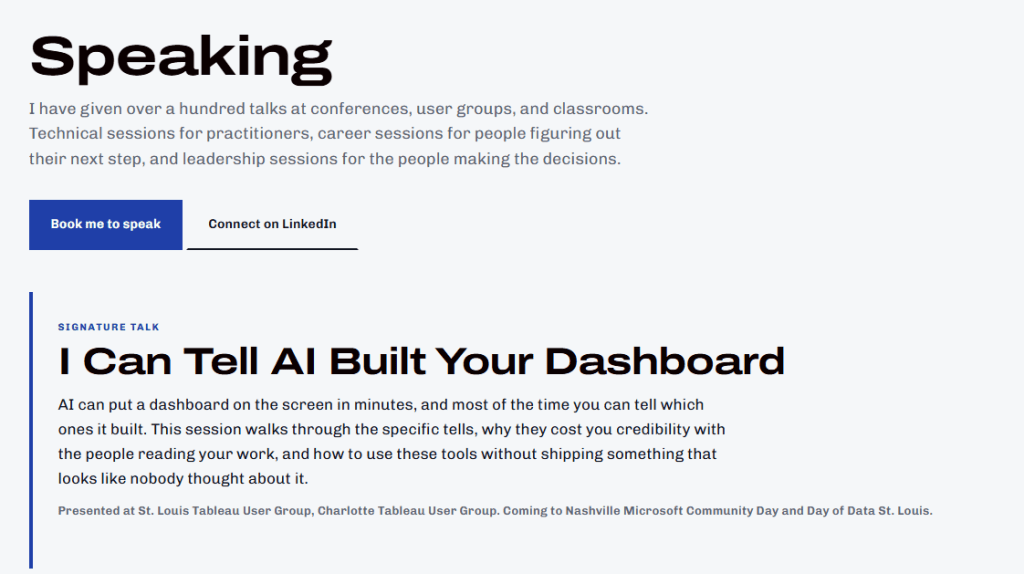
Eighteen years of Excel, BI, data, and now data and AI, over a hundred talks, more than a hundred podcast episodes, all of it finally living on pages that connect to each other instead of sitting in separate corners of the internet.
If you’ve got a WordPress site sitting there half-finished
You don’t need to be technical to do this. If you can describe what you want clearly and you’re willing to look at real pages and say “closer” or “not that,” an agent connected through something like Novamira can do the rest, PHP execution, file edits, debugging its own mistakes, while you make the calls. That’s true whether you’re a data person like me, a small business owner, or anyone else with a WordPress site that’s been sitting half-finished for longer than you’d like to admit.
What’s sitting half-finished on your end, a website, a dashboard, a project you’ve been meaning to get back to? I’d genuinely like to know what you’d point an agent at first.
Field notes on Power BI, Tableau, Fabric, Snowflake, and Databricks from someone shipping this work for real clients. Free, most weeks.